Merel's pension horizon
If you are still accruing pension on 1 January 2027, you are entitled to contribution compensation.
Under the new rules, there will be various changes to your pension accrual. For some people this is disadvantageous. If you are 37 years or older, you are likely to accrue less pension in the future than you would have under the old scheme. This is why, on the date of the transition to the new pension scheme, you will have an additional amount deposited in your pension pot.
Merel's pension horizon

Here are the key rules that play a role in this regard:
▶ You will only receive this amount if you are still accruing pension with Pensioenfonds PDN on 1 January 2027.
▶ If you change jobs before 1 January 2027, check whether your new pension fund will pay this contribution compensation!
▶ Reducing your hours or taking unpaid leave before or with effect from 1 January 2027 will adversely affect your contribution compensation.
Will your pension horizon remain on track?
You may need contribution compensation for this. Take just 6 minutes to gain an understanding of what contribution compensation is and which choices can affect it.
Watch the contribution compensation video below!
Frequently asked questions about contribution compensation
General
What is contribution compensation? +
Contribution compensation is intended to compensate for the disadvantage that some members will experience as a result of the transition to the new pension scheme. This disadvantage arises because the redistribution of contributions from younger to older members will cease. The compensation helps to offset this disadvantage.
When are you entitled to contribution compensation? +
You are entitled to contribution compensation if, on 1 January 2027, you meet the following conditions:
- You are employed by a company affiliated with PDN, or you became disabled on or after 1 January 2007.
- You are still accruing pension with Pensioenfonds PDN.
- You meet the age requirement. According to the current scale, this is between approximately 37 and 67 years of age.
The amount depends on your age and your pension base.
What does contribution compensation mean in euros? +
The amount of the contribution compensation depends on your age and your pension base. In the video, we use Merel as an example. She is 40 years old and has a salary of €80,000. According to the contribution scale currently known, her contribution compensation amounts to approximately €9,500. If she retires at 67, we expect her pension to be approximately €620 gross per year higher as a result. Please note: this is an example. We will only be able to calculate the exact amounts at the start of next year.
View more examples here, featuring different ages and salaries.
Look for the age and salary that most closely match your own. This will give you an indication of what the contribution compensation will mean for your pension.
Why is there a limit on the salary on which contribution compensation is calculated? +
There is a limit on the amount on which pension contribution compensation is calculated. You only receive pension contribution compensation for your pension under the basic scheme. And that scheme applies up to a pensionable salary of a maximum of 137,800 euros*. This limit is set by law for pension accrual. The portion of the salary above this amount does not count towards pension accrual under the Pensioenfonds PDN pension scheme. Therefore, contribution compensation is calculated only on the salary up to this limit, minus the excess.
Fictitious example:
John has a pensionable salary of €144,000 per year. For the calculation of the contribution compensation, a maximum of €137,800 of his pensionable salary is taken into account. The salary above this amount is not taken into account.
The excess is then deducted from this amount (€19,172 in 2026). This brings his pensionable income to €118,628. His contribution compensation is calculated on the basis of this pensionable income.
*Please note: the video refers to a maximum pension base. This is not entirely correct. What is meant here is the maximum pensionable salary of €137,800.
Can you calculate the contribution compensation for yourself? +
You will see the final amounts in your final statement of your new pension during 2027.
Would you like to get an initial idea of the contribution compensation and what it means for your pension at the age of 67? Then check the table of calculation examples to see which age and salary best match your situation.
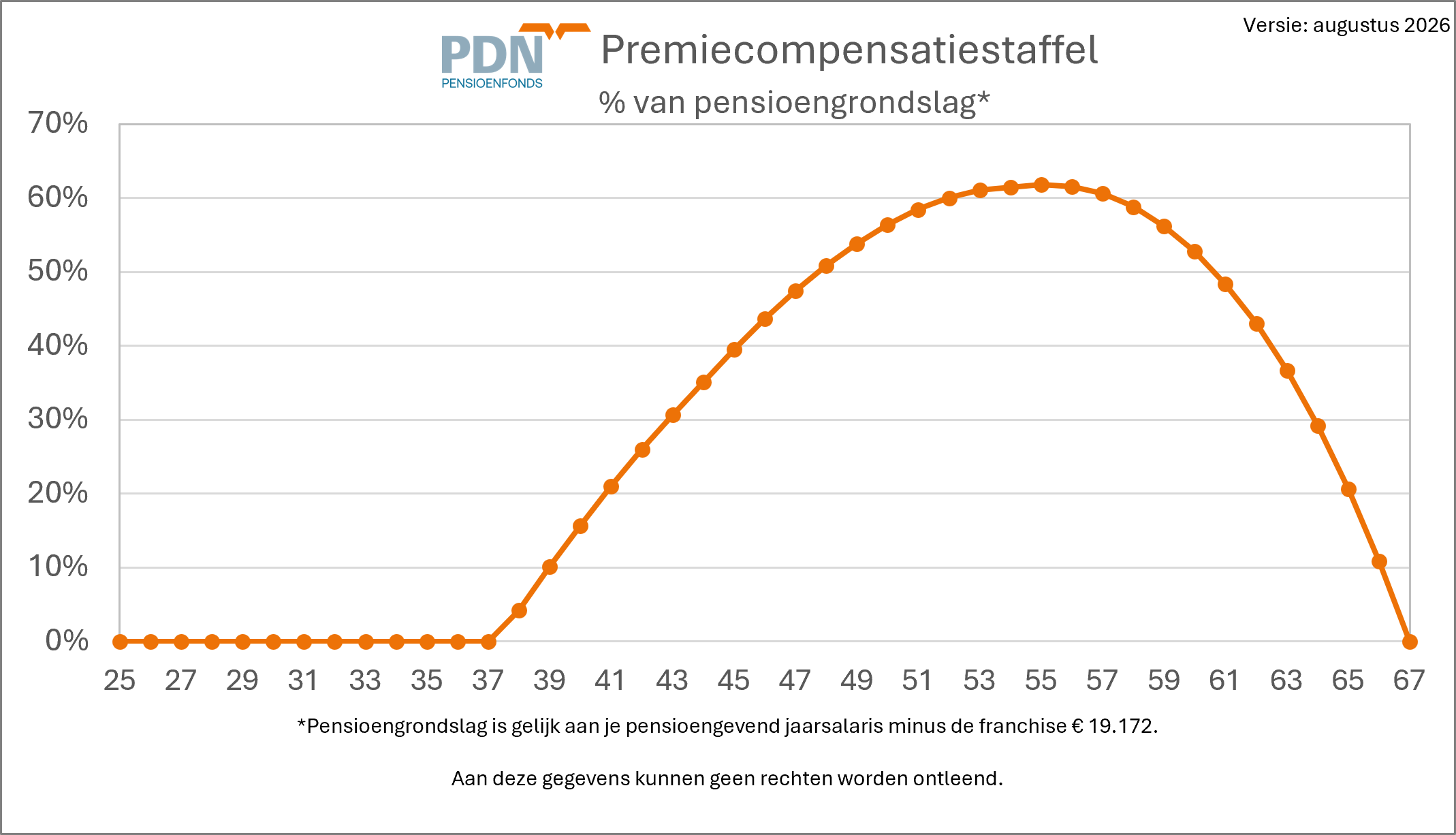
Would you like an insight based on your own situation? We calculate contribution compensation based on your pensionable income. This is your pensionable salary minus the franchise (the portion on which you do not accrue pension because you will also be receiving the state pension). In 2026, this franchise will be €19,172; the pensionable salary is capped at €137,800. You can find your full-time pensionable salary in ‘My PDN’ under ‘My Details’. Subtract the franchise of €19,172 from that full-time pensionable salary. If you work part-time, you must multiply this result by your part-time percentage. Using the amount you are left with, refer to the contribution compensation scale below. Select the contribution compensation percentage that corresponds to your age and work out for yourself what your contribution compensation will be approximately.
Please note, however, that this is only an estimate of your premium compensation. We will not be able to calculate the exact amount of the premium compensation until early 2027.
 |
Events
What happens if you start working fewer hours before 1 January 2027? +
In that case, your contribution compensation may be reduced. This is because the amount of compensation depends, amongst other things, on your pension base on 1 January 2027. If you work fewer hours, your pension base will be lower and, consequently, so will your contribution compensation.
What happens if you wish to take extended leave before 1 January 2027? +
In that case, it is important to check whether your pension accrual will continue during your leave. If your pension accrual stops, you will not be entitled to contribution compensation. In that case, it may be wise to consider whether you can postpone the start date of your leave until after 1 January 2027.
Fictitious example: Sara and Merel:
Sara has been dreaming of traveling the world for years and wants to make that dream a reality before January 1, 2027. Her employer gives her the opportunity to take extended leave. Together, they agree that her pension contributions will continue during her leave. This option is not automatically available with every employer.
Merel discovers this as well when she discusses her plans for extended leave with her employer. In her case, continuing pension contributions during her leave is not possible. If she nevertheless takes extended leave before January 1, 2027, this will affect her eligibility for premium compensation.
Pension contributions during leave are therefore not a given. If you are considering taking extended leave before January 1, 2027, discuss with your employer whether it is possible to continue building up your pension during your leave.
What happens if you stop working before 1 January 2027? +
If you stop working before 1 January 2027 and start drawing your pension, you will not be entitled to contribution compensation. The compensation is linked to your employment status on 1 January 2027. If you are no longer accruing pension on that date, you will no longer meet that condition. If your pension accrual stops before that date, check under ‘Retiring earlier’ to see what this means to you.
What happens if you leave your job on 1 January 2027? +
In that case, you will not meet a key condition for contribution compensation under the PDN scheme. On 1 January 2027, you must be employed by a company affiliated with PDN and still be accruing pension with Pensioenfonds PDN. If you are no longer in employment or if you change jobs before 1 January 2027 to work for an employer that is not a member of PDN, your entitlement to contribution compensation from PDN will lapse. You may, however, be eligible for contribution compensation from your new pension fund. Please check this with that fund’s helpdesk.
Do participants who are occupationally disabled also receive contribution compensation? +
Yes, if you became occupationally disabled on or after 1 January 2007 and are still accruing pension.
These are the key rules that apply:
▶ You will only receive the amount if, on 1 January 2027, you are still occupationally disabled and are accruing pension with Pensioenfonds PDN
▶ The degree of your disability on 1 January 2027 determines the amount of your contribution compensation. If you are permanently disabled, you will receive 100 per cent compensation and if you are, for example, 50 per cent disabled, you will receive 50 per cent contribution compensation.
If you are also accruing pension with PDN for the part of your working capacity, you will of course receive contribution compensation for that as well.
For the most part, the video also applies to anyone who has become (partially) disabled on or after 1 January 2007. ‘In employment’ is the same as ‘the rate at which your pension accrues’. Working fewer hours is then the same as becoming ‘your degree of disability becoming less’, which means your contribution compensation will be lower.
However, if this enables you to work more for one of our affiliated employers and you consequently earn more, your contribution compensation will actually increase as a result.